

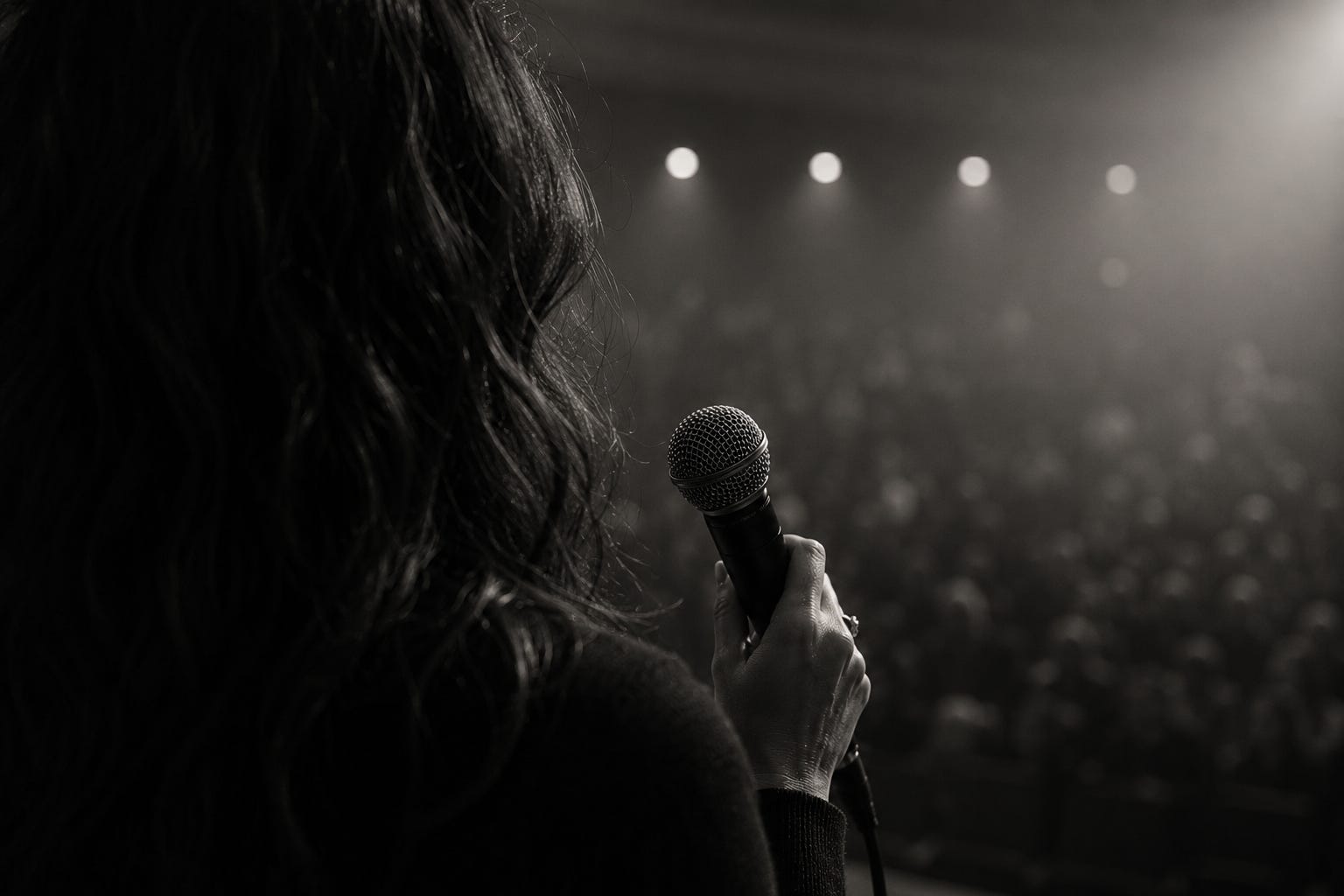
There is a thing that happens in the car. A song arrives in my head — half of it, the good half, the part everyone remembers — and I begin to sing it. And before I reach the end of the line, without a word, my husband finds it on the screen. The real one. Cues it up at volume, and the actual singer arrives to take the song off my hands.
He is not unkind about it. There’s no actually, it goes like this, no lesson, no sigh. He simply produces the correct version and lets it play, the way you’d hand someone the right tool without comment. The song I was reaching for arrives, sung properly, by a professional, and my own goes quiet under a louder, more perfect one.
My husband can sing, is the background to this. Not shower-sing — actually carry a tune to where it was going and set it down intact. I cannot. I am, and I have made my peace with the ranking, the best in a row of bad singers — which is a category of compliment that dissolves the second you look straight at it. For twenty years the right voice has been quietly replacing mine in moving vehicles, and for most of them I received it as help.
It took an embarrassing while to notice that the help might not be for me.
Because here is what a wrong note does to a person who sings well: it hurts them, the way a picture hung crooked hurts you until you straighten it. He isn’t teaching me — I’ve proven, across two decades, unteachable in this exact way — he is relieving something. The gesture is aimed at me, but the relief it brings is his. I say this without grievance; we’re long past the years when it would’ve been a fight, we are still very much in love, and I can watch him do it now with faintly scientific amusement rather than a slammed door. There’s a specific small comedy in being edged out of your own song by a machine — a whole living woman, replaced mid-verse by the definitive recording.
And I had a whole essay ready to go from there. You can see its shape. The one about how we should all be allowed to make the joyful wrong noise, do the thing without being good at the thing —
I can’t write that essay, though, and the reason is the other thing I do — the thing I love too much to leave alone, that I direct on nights and weekends for audiences who have paid to be there.
I direct dance — not professionally, but with something more compromising than a paycheck at stake. It’s the thing I chose, and I made myself its bouncer. The room where I love it most is also the room where I stand at the door and decide who is good enough to be seen doing it. I hold auditions. And at an audition I don’t correct anybody either; I do exactly what the screen does. I replace them. I watch someone dance with their whole heart, not quite rightly, and I think, with total clarity, no — and I find the one who does it properly and that dancer goes on stage instead. He substitutes the right voice for mine in a car. I substitute the right body for the eager one in a theatre. Same gesture. Mine has a lighting budget.
So I don’t get to write the pretty essay. The woman who wants to be let into singing on no qualification is the same woman who guards the door to the dance she loves so much.
I have tried the exits, and none of them holds. Singing is joy, dancing is craft — but I dance craftlessly in the kitchen for no one, and I’d be insulted if you filmed it and sold tickets. The car is private, the stage is public — but I have silently judged a stranger for singing flat two tables over. It’s only a side thing — except the side things are the ones you chose, which makes the strictness worse; nobody made me guard this door, I volunteered. Every distinction is true, and every one leaks. I am tender about the filter when it’s aimed at me and ruthless with it when I hold it, and I have not found the version of myself who reconciles those two women.
What I keep returning to isn’t the hypocrisy. I can live with a hypocrisy; most working lives are built on one. It’s the quieter thing under it: I want, more than is quite reasonable, to be the one who sings well. Not to be let to sing — I already am, the car is a democracy, the phone can’t actually stop me — but to be good at it. To open my mouth and have the right note come out, no professional required, no recording necessary. I hold that standard so fiercely, in the room I love most, precisely because I know what it’s worth. I have no intention of lowering it — not for the dancers, not for anyone. I would simply like to be excused from it — just me, just the singing — and I would like that very much.
I am not proud. I am, however, still singing.
You could take lessons, Mo. It’ll keep you young longer too - learning of any new skill will.
I love that you’re still in love!
Gaga Mo!!