
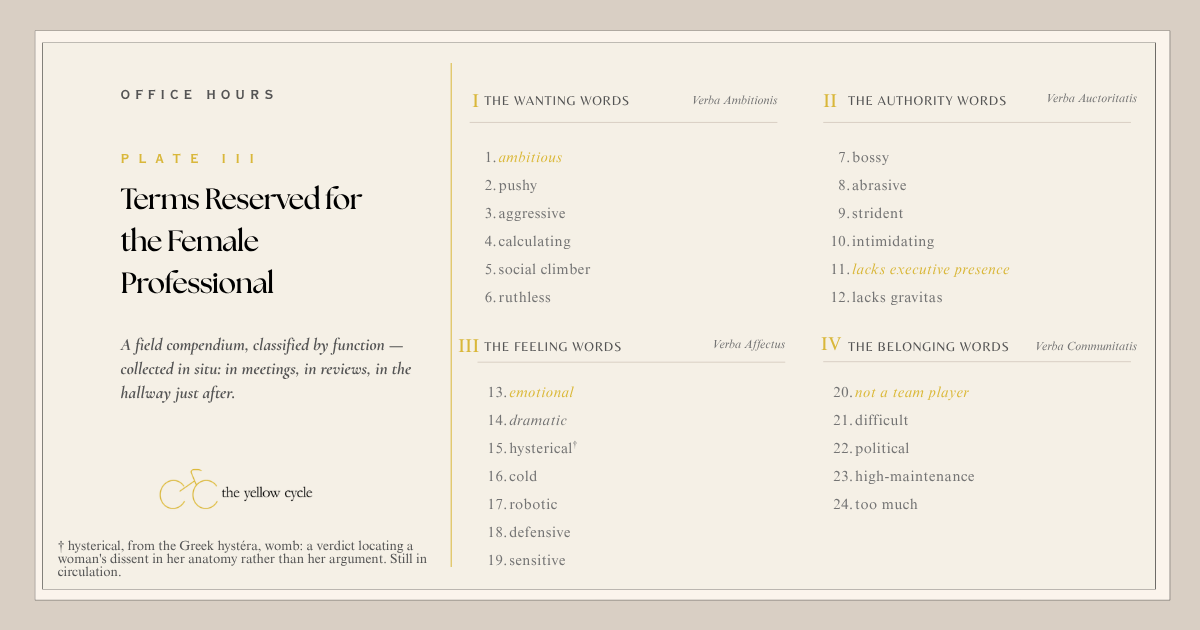
Certain words behave differently depending on who they land on. Said of a man, they are neutral, sometimes admiring — a description of a way of being, no more. Said of a woman, the same words acquire a second meaning, a verdict, a small clinical chill, and begin to function less as observations than as labels — meaning: adjustments are required, or else.
The evidence is easiest to see at altitude. Consider the woman in public life who is decisive in precisely the way the man beside her is decisive — and who is called something sharper for it: calculating where he is analytical, cold where he is disciplined, ambitious where he is simply focused. We do not need her name. We supplied it while reading the sentence, which is the entire point: the pattern is legible enough that a face arrives unbidden, and no equivalent face arrives for the man.
And here is the complication that keeps this from being a tidy grievance. Some women have learned to lead hard on purpose. One executive, asked why she led with her chin in every meeting, said flatly that she had spent a decade being talked over and had simply stopped waiting for space that was never offered. She was not born abrasive. She had had to tune herself — gradually, deliberately — to the one frequency that carried over the clamor of the room, and was then handed the verdict for the tuning as though it were a flaw in her character rather than a solution to the room’s. The words that follow cannot tell the difference between a woman who is truly difficult, a woman who was made difficult in self-defense, and a woman who is only so labeled. That inability is how a fix gets recorded as a defect.
So: four of many artifacts, probed below. Each entry notes the same three things — the meaning the word carries when it is doing what it’s supposed to; the conditions under which the trait is genuinely insufferable, man, woman, or otherwise, because pretending otherwise would be naive; and the method by which the word, examined at close range, tends to fall apart in the hand of the person voicing it.
Too Ambitious
In use: A word that curdles into a warning only when its subject turns out to have more of the quality than the speaker had braced for. Applied to a woman, ambitious is less a description of her than a measurement of the distance between what she wanted and what she had been quietly assigned to want. The gap is the offense. The word only names it.
Genuinely insufferable when: ambition arrives detached from any interest in the work itself — the person who wants the corner office and none of the labor that is supposed to lead there, who treats colleagues as rungs. That exists, and it grates, in anyone. But note how rarely ambitious is the word spent on him when it does.
Fielded: The response is not to deny it, because denial concedes there was something to be ashamed of. It is to accept the word without a flicker and ask, warmly, what the preferred alternative would have been. No one has ever completed the sentence we would have liked you to want a little less out loud, in daylight, and remained standing.
Overly emotional
In use: A word one or two removes from a literal medical diagnosis — hysteria, the wandering womb — and not as many removes as you’d hope. Show feeling and you are emotional; withhold it and you become cold; the strip of sanctioned warmth between the two is narrow enough to fail on an ordinary Tuesday. Which tells you the word is not measuring the reaction at all. It is measuring the observer’s comfort, and filing the result as a fact about her.
Genuinely insufferable when: the feeling is a tactic — the performance of distress deployed to end a conversation or relocate its blame. That, too, exists, in anyone. It is also vanishingly rare compared to the number of times the word is used to describe a reaction that was simply the correct size.
Fielded: The reply is a single question, asked levelly — which part, exactly, was disproportionate: the feeling, or the thing that caused it? The accuser has usually not thought past the feeling, and rarely enjoys being escorted back to the cause.
Not a team player
In use: Dissent, entered into the permanent record as a defect of personality. Original thought, refusal to ratify the room’s consensus, not appreciated. The recategorization is the whole maneuver: a disagreement about the work is refiled as a flaw in the woman, where it can be managed by HR rather than answered on the merits.
Genuinely insufferable when: the person really is a menace to the collective — hoarding credit, withholding information, treating the people beside her as terrain to be crossed. This is real, and it is intolerable in anyone: man, woman, child, or, on a sufficiently bad day, animal. But that person is loud about herself. The woman the phrase usually lands on was loud about the problem, which is a different thing wearing the same word.
Fielded: Ask what, precisely, the team was playing — and whether the difficulty was the person, or the fact that she was right where everyone could see it. A team that functions only for as long as no one disagrees is an arrangement, and an anxious one. Naming it as such tends to conclude the meeting.
Lacks executive presence
In use: The most elegant of the four, because it arrives pre-equipped with a definition and still manages to mean nothing. The authoritative version belongs to the economist Sylvia Ann Hewlett, who resolved executive presence into three parts: gravitas (how one carries authority and holds up under pressure), communication (how one speaks and commands a room), and appearance (how closely one matches the picture of a leader already in the viewer’s head). A genuinely useful taxonomy — right up until you ask how any of the three is measured, at which point all three dissolve into the same answer: by the gut of whoever is doing the looking.
Gravitas is poise, as read by the reader. Communication is articulacy, as judged by an ear tuned to a particular frequency. Appearance is resemblance to a template one is simply used to looking at. The framework does not measure presence; it sorts a single instinct into three bins and returns it wearing the authority of a rubric. Its natural habitat is the withheld promotion and the truncated presentation — one manager cut a woman’s presentation short, wanting the room’s attention for himself, then recorded her lack of presence as the reason she had failed to hold it.
Genuinely insufferable when: Never. But here the concession can begin, because there is a real thing at the bottom of the first pillar — some people genuinely come apart under pressure, cannot hold a decision, cannot make themselves understood in a room that needs them to. That exists, in anyone, and it is a real limit.
But watch what the term does with it: it binds that one measurable deficit to “sounds like us” and “looks the part,” scores the bundle as a single impression, and lets the assessor lean on whichever of the three justifies the conclusion he reached before she opened her mouth. The honest kernel is the alibi for the other two.
Fielded: Disassemble the finding. Ask which of the three — gravitas, communication, or appearance — was found wanting, and by what measure. Press gravitas and it becomes did she seem sure of herself, to me. Press communication and it becomes did she say it the way I would have. Press appearance and the honest answer, said aloud, is usually a description of a man. The aim is not to win the exchange. It is that a standard which cannot survive the question by whose measure? was never a standard. It was a preference with a corner office.
Read the four together and the shape is the same. None is a measurement of the woman. Each is a confession the room made without meaning to. So when it arrives, turn it around, without heat. And ask what it’s measuring. You owe it nothing.
Learning and loving! “you owe it nothing”! Bravo. Also, thanks for bringing me to Substack