
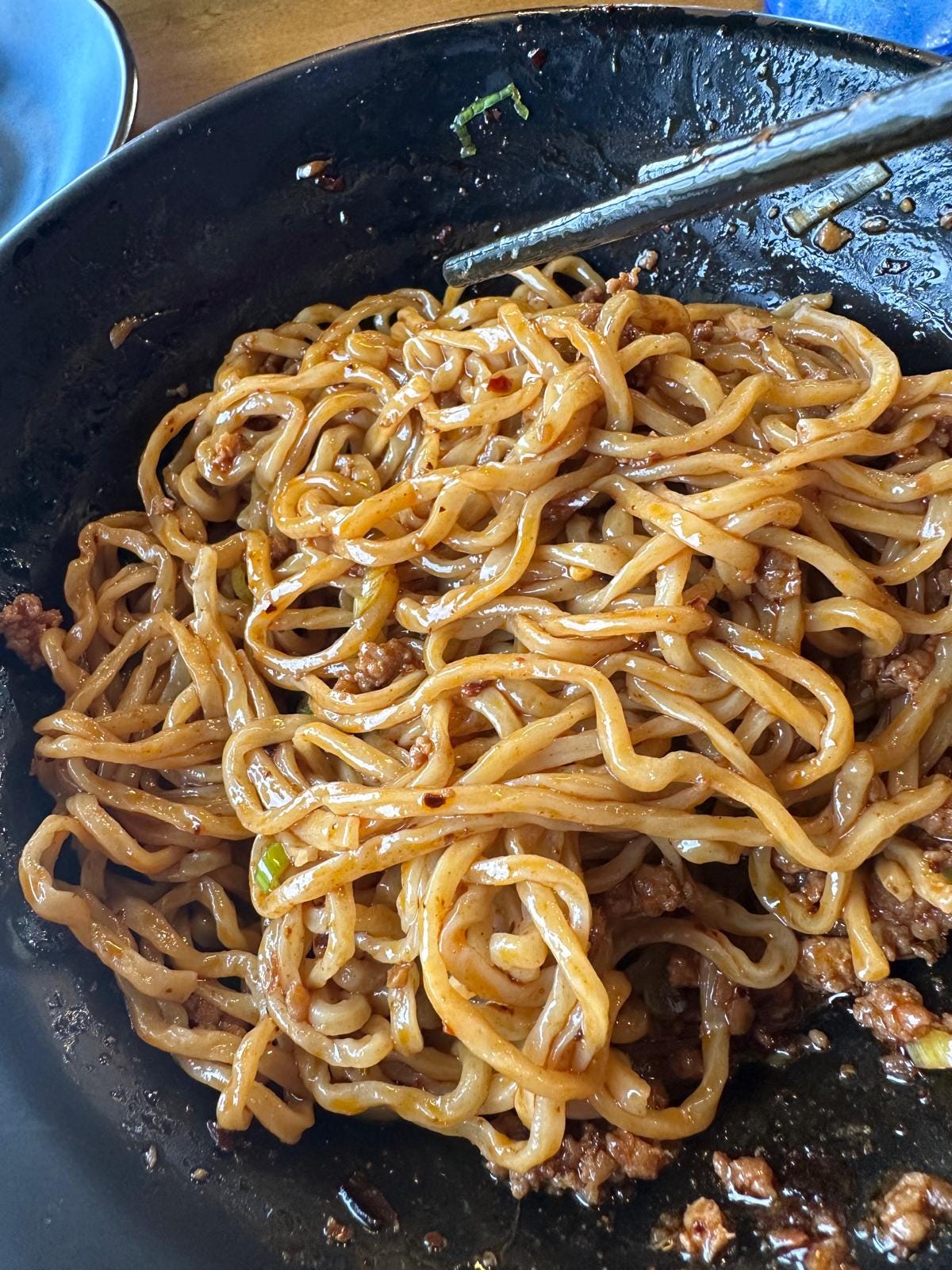
Let’s talk about foods that permit dignity. Steak, certainly. A neat arrangement of knife and fork, small bites, occasional wine. Sushi, if you know what you’re doing. Even soup, sometimes. A noodle, alas, has other plans.
It dangles. It escapes. It flicks sauce onto the white shirt you should have known better than to wear. One end can be halfway down your throat while the other remains firmly committed to the bowl. There comes a moment in almost every noodle meal when you must choose between elegance and eating.
Choose the noodle. Please. We have been doing so for a very long time.
Four thousand years of a very good idea
In 2005, archaeologists working at Lajia in northwestern China reported something extraordinary: beneath sediment, inside an overturned earthenware bowl, were noodles. Actual strands, preserved for roughly 4,000 years.
They were thin, long, yellow and—here is the surprise—made from millet, not wheat or rice. Researchers concluded that people in Late Neolithic China were already grinding grain, making dough and repeatedly stretching it into long strands before boiling it.
Which gives China the oldest physical noodles yet discovered.
It does not quite answer the question everybody immediately wants answered: Who invented the noodle?
China? Italy? The Arab world?
Food historians have spent considerable energy on this. The noodle, having survived four millennia perfectly well without intellectual property counsel, has become a small geopolitical problem. The famous solution offered to generations of schoolchildren was Marco Polo. He went to China, encountered noodles, returned to Venice in 1295 and gave Italy pasta. It is an excellent story. It is also not true.
Pasta was already known in Italy. A Genoese document from the 1270s mentions macaronis, while the Arab geographer al-Idrisi had described pasta production in Sicily more than a century before that. The passage in Marco Polo’s own travels that supposedly proves the Chinese connection describes a starchy substance from a tree—probably sago—which he compared with food he already knew at home.
Marco Polo did not bring spaghetti to Italy. We should perhaps forgive him. He never said he did.
The more interesting answer is also the messier one: like most good things, noodles do not require a single inventor. Give human beings grain, water, hunger and enough time, and apparently someone eventually looks at the dough and thinks: What if we made this extremely long?
The noodle is a map
What happens next depends largely on where you are standing.
Where wheat grew, wheat became noodles. Where rice dominated, rice became noodles. Buckwheat became soba. Mung bean became translucent glass noodles. Sweet potato starch became the extraordinarily chewy Korean dangmyeon. Durum wheat became the great dried pastas of Italy.
And then people moved. The noodles moved with them.
Ramen is now so completely associated with Japan that it can be easy to forget its Chinese roots. Chinese-style wheat noodles were being served in Tokyo by the early twentieth century; Japan took the idea and proceeded to regionalize it with magnificent enthusiasm. Kansui—the alkaline solution that gives ramen its characteristic spring—helped distinguish the noodle from the udon and soba already embedded in Japanese cooking.
Migration can produce entirely new noodles, too. After the Korean War, refugees from northern Korea settling around Busan could not easily obtain the buckwheat used in northern cold noodles. Wheat arriving through American food aid was available. Wheat, mixed with potato or sweet-potato starch, became milmyeon—a Busan noodle born from displacement, scarcity and substitution.
A bowl of noodles can therefore tell you what grew somewhere. It can also tell you who arrived, who left, what was scarce, what was traded, and what people cooked when the ingredient they remembered from home was no longer available.
That is a whole lot of memory for flour and water.
And then you have to eat the thing
This is where noodles become particularly revealing.
Because humanity may broadly agree that long strands of starch are desirable. We absolutely do not agree on what a civilized person should do with them.
Consider the slurp.
If you grew up being told that audible eating signaled the imminent collapse of society, Japan presents a delightful adjustment. Slurping ramen, soba and udon is perfectly acceptable. For a culture with such elaborate codes around public behavior, the sanctioned racket of a noodle shop feels like a magnificent little exception.
And there is something wonderfully liberating about a food culture that acknowledges the mechanical reality of the object. The noodle is hot and it’s slippery. You have chopsticks. Proceed accordingly.
Travel a little farther and the rules rearrange themselves again.
At a Vietnamese street-food stall, the noodle bowl arrives not so much finished as ready for negotiation. Herbs and leafy greens accompany noodle dishes; chile, lime, fish sauce, garlic vinegar and other condiments sit within reach. You adjust. Taste. Adjust again. The bowl becomes yours.
In Korea, meanwhile, there are scissors.
Actual scissors.
They appear at the table for barbecue, kimchi and cold noodles, and nobody regards this as evidence that the diner has failed some fundamental noodle examination.
Although even Korea refuses to make the matter simple. Some specialists insist certain chewy noodles taste better uncut: a Korea.net account of Busan milmyeon notes that chefs recommend leaving the strands whole because cutting them can compromise their texture.
So even the rule about there being no rule has an exception.
Italy, meanwhile, hands you a fork. There is a beautiful confidence in this. Here is your spaghetti. Here is one small metal implement. We have been doing this for some time. You’ll work it out.
Same problem. Entirely different civilizations of the mouth.
The long and short of it
Sometimes the length itself means something.
Chinese longevity noodles—changshou mian—turn the unbroken strand into a wish for long life. Their length is the symbolism. Cutting them rather defeats the message.
Japan has its own version of the metaphor. On New Year’s Eve, toshikoshi soba—literally “year-crossing soba”—marks the passage into the new year. The long, thin noodles have come to represent longevity and good fortune.
Italy would like a word
At some point we must address the question capable of ruining an otherwise agreeable dinner: Is pasta a noodle?
There are several possible answers.
The taxonomic answer is: close enough that a neutral observer can see why the question arises. Special mention here to a former colleague who once looked an Italian straight in the eye and informed him that his carefully constructed pasta was, after all, just another noodle. We shall not go into what followed. It was not a productive afternoon at work.
But the culinary answer to this question is: that is really not the point.
Which brings us to perhaps the most important thing about learning noodles properly: the chew. Texture matters enormously. Italian cooking gave the world al dente: literally, “to the tooth.” The pasta should offer resistance. Taiwan has something even better: Q.
Q describes a particular pleasurable springiness or chew—the bounce of a fish ball, the elasticity of a noodle, the resistance of a tapioca pearl. QQ intensifies it. Michelin describes it as something like an Asian cousin of al dente: soft, but emphatically not mushy; yielding, then bouncing back. Once you notice texture, the noodle aisle changes completely. A glass noodle is supposed to be slippery. A good ramen noodle should push back. Udon has heft. Soba has tenderness and grain. Dangmyeon has that glossy, elastic chew that makes japchae what it is. Rice vermicelli is light enough to disappear among herbs. Biang biang noodles arrive like belts.
And this is why replacing one noodle with another because they are both “Asian noodles” is rather like substituting mozzarella for Parmesan because both are cheese. Dinner will occur. That is about all we can promise.
But when in doubt, here's the compendium we promised — quick enough to consult mid-aisle, right as the unease sets in.
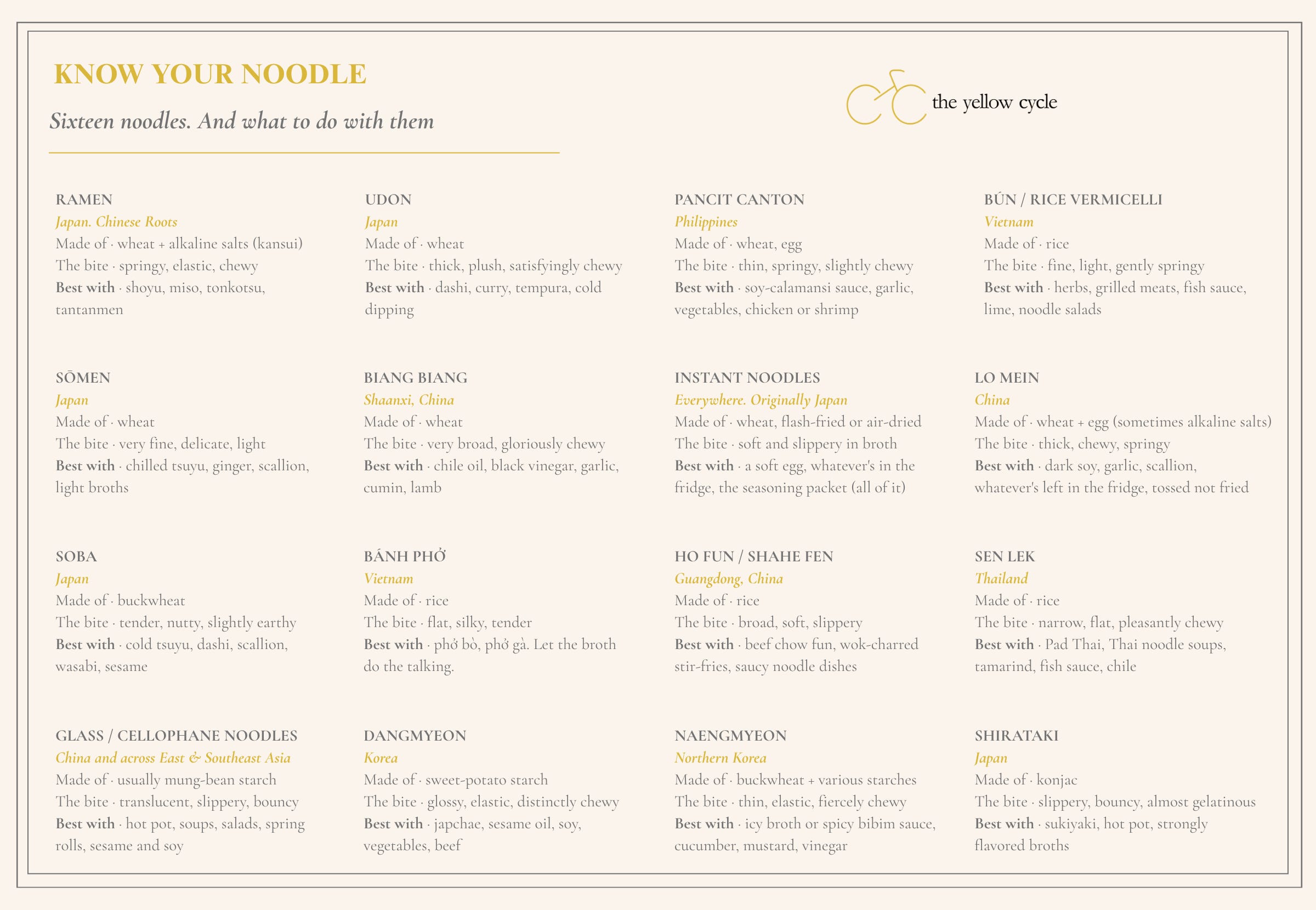
There is no best noodle in this table. That would be a ridiculous thing to suggest. And perhaps this is why noodles have survived every attempt to make them merely fashionable.
A noodle is not precious. Even when making one requires considerable skill—the slap and stretch of hand-pulled dough, the practiced knife cutting soba, the exact alkaline chemistry of ramen—the final instruction is always the same.
Eat it. Before it swells in the broth. Before the sauce congeals. Before the perfect chew disappears.
Someone may have spent hours making the stock. Someone else spent years learning the dough. Behind both may sit a recipe, a migration, a crop, a grandmother, a war, a trade route, an entire argument about whether the strands should be cut.
And then you sit down. Slurp. Twirl. Snip. Twelve minutes later, the bowl is empty.
That is the peculiar art of food: enormous human effort devoted to making something whose highest purpose is to disappear.
And yet the good ones don’t.
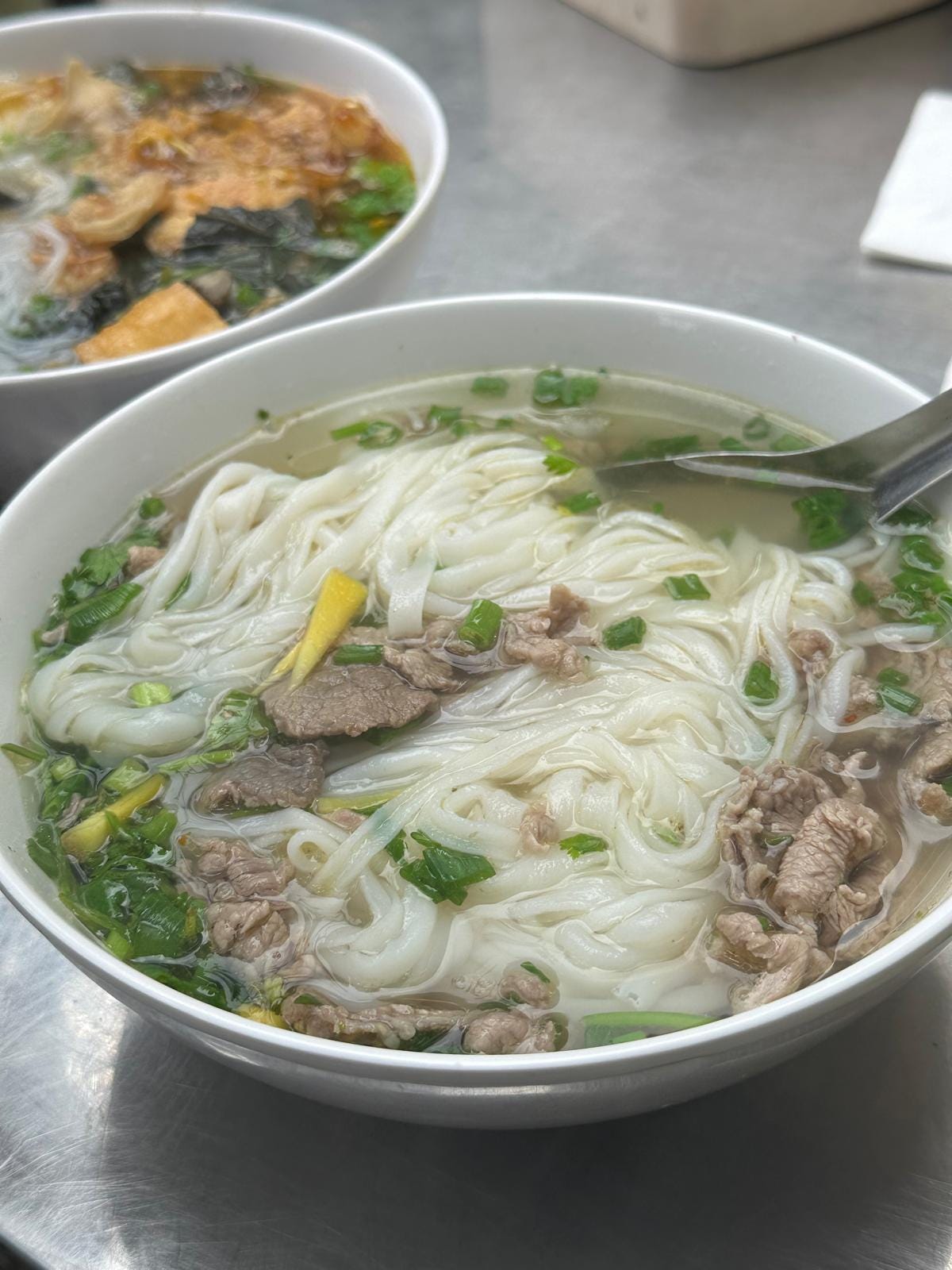
You remember the ramen shop at an inconsequential strip mall. The phở eaten on a plastic stool at a dusty Hanoi intersection. The bowl that your neighbor brought in when you were ill. The terrible hakka noodle you had at the generic “Asian street food stall” at a city you’d just moved to. The noodles your mother cooked without ever measuring anything, which you now cannot reproduce despite possessing both the recipe and considerably better equipment.
The noodle disappears. The rest, inconveniently, enchantingly, stays.
Great article, Mo. Origins aside, it is fascinating how different cultures take the same base and make it their own. The Indian subcontinent and the Middle East have put their stamp on the noodle too.
In its plainest Indian form, the noodle is idiyappam but pair it with vegetable stew and it's yummy breakfast. Add tadka and spices, it becomes vermicelli upma. Sautee it in ghee and then cook in milk with sugar, saffron and cardamom for kheer or savor it in the rich, delectable sheer kurma. Fancy dessert, then look no further than falooda with glass noodles at the bottom of a glass filled with chilled rose flavored milk, basil seeds and jelly pieces. And who doesn't love a good Turkish kunefe or a bird's nest baklava?