
Cancer is a name we gave to more than a hundred different diseases. They share one symptom — cells that won't stop dividing — and little else. Every cell in your body carries the same directions and divides on a schedule: replace what wears out, repair what tears, then stop. Cancer is that last instruction failing — a cell that keeps dividing past the point it was told to stop, and passes the malfunction on every time it divides again. The mechanism is as old as multicellular life, because it's the same one that builds a body in the first place. There's no version of a body that can heal a paper cut and can't also make this exact mistake. And this is completely by design.
This is also why there's probably no single cure — "cure" doesn't mean much for a category this wide, any more than a single fix would mean anything for "illness." What this column wants to deal in isn’t certainty, but a set of questions. Screening changes the odds of catching something early enough to matter, nothing more. It works only in the specific places where early actually helps. Vigilance without certainty is an odd instrument to be handed, and most of us are never taught how to hold it: how to be careful without pre-grieving a diagnosis you don't have, how to walk into a screening room informed rather than braced. That's the actual subject here — what it takes to be prepared for something you can't fully know.
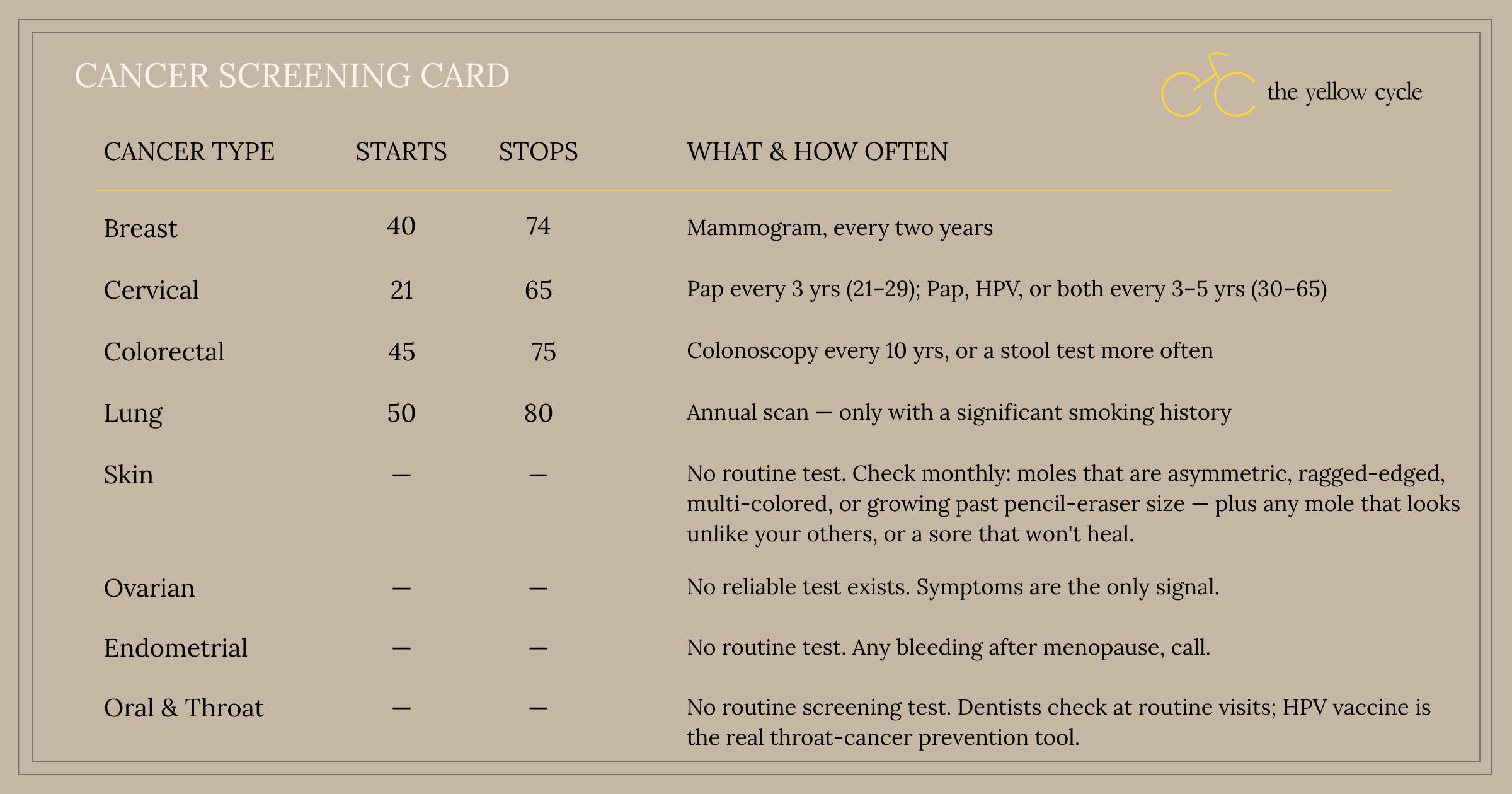
Here is a thing almost nobody says to you plainly: the age you memorized for your first mammogram is already wrong. It moved from fifty to forty in 2024, and most of us are still carrying the old number around with no memo telling us to update it. Colorectal screening moved too, from fifty to forty-five, back in 2021 — and most newly eligible people still don’t know it. Lung cancer has a test too — an annual scan, but only if you have a real smoking history — and it kills more women than any other cancer.
Cervical screening has had the busiest few years of any test here: a self-collected swab instead of a speculum, cleared for clinics in 2024 and for home use in 2025, now a preferred option under federal guidance. One catch — full insurance coverage doesn't arrive until 2027.
Ovarian cancer has no recommended screening test at all — because the available tests caused more harm than good, flagging cancer in women who didn’t have it often enough to send many of them into unnecessary surgery. The absence of a test here isn’t the system failing you. It’s the system telling you the truth about what it can’t yet do. Endometrial cancer has the same gap — no routine test — but a simpler answer: any bleeding after menopause gets a prompt call, not a wait-and-see.
Skin is the odd one out: no routine screening is recommended for the average adult, even though most dermatologists will still tell you to get a new mole checked. Both things are true. The data hasn’t caught up to the intuition yet. Mouth and throat work the same way, with a wrinkle. The exam your dentist gives your mouth and throat isn't what the "insufficient evidence" verdict is even about — it's specifically about primary care doctors, and dentists keep checking anyway as routine practice. Throat cancer has no screening test either, and its biggest driver has shifted: oropharyngeal cancer is increasingly an HPV story, which makes the vaccine, not a screening visit, the actual prevention tool. Thyroid cancer flips it again: the guidance here is an active recommendation against screening, because ultrasound finds so many slow-growing cases that the biopsies and surgeries that follow do more harm than the cancer would have — and it’s nearly three times more common in women than men.
All of this — the ages, the intervals, the absences — describes the average-risk woman, which is a real category and also not necessarily yours. A parent diagnosed young, a genetic marker in the family, a prior finding of your own moves every number on this page. So does something the guidance is only recently starting to say out loud: Black women are diagnosed with breast cancer at roughly the same rate as white women — slightly lower, in fact — and die of it at a rate 40 percent higher, a gap that roughly doubles for women diagnosed before 50. It’s driven partly by more aggressive disease and partly by everything that happens, or doesn’t, after a mammogram — which is the case, still being built, for starting the conversation earlier rather than waiting for the standard number to arrive.
The same gap between what feels reassuring and what’s actually been proven shows up somewhere else, too — in a doctor’s office brochure, a wellness clinic’s intake form, promising a single blood draw or a whole-body MRI that looks for dozens of cancers at once instead of one at a time. The appeal is obvious. The evidence isn’t there yet: Galleri, the best-known blood test, still isn’t FDA-approved, and its largest trial missed its main goal of catching more late-stage cancers early. Whole-body MRI, tested in over 9,000 healthy people, found cancer in under 2 percent of them — with biopsy rates swinging from 2 to 22 percent across clinics and no shared rulebook for what a finding should trigger next. These tests are simply ahead of the science that would tell you what to do with what they find. The cheaper, better-tested version of the same idea is one you already have: know your own body well enough to notice fatigue that doesn’t lift, a new lump, weight loss you didn’t work for, bleeding that shouldn’t be there. It won’t catch everything early. Neither, yet, will the thousand-dollar scan.
None of this is a verdict. It’s a starting point, and one worth walking into an appointment already knowing, because a guideline is a floor, not a ceiling, and the difference between the two is exactly the conversation most of us never get to have. The full breakdown — what’s asked of you and when, and which column you’re actually standing in — runs alongside this piece.
WHICH COLUMN ARE YOU IN
Check anything that applies to you:
☐ A parent or sibling diagnosed with a related cancer before 50
☐ Two or more relatives with the same or a related cancer (breast and ovarian count as related, so do colorectal and endometrial)
☐ A known BRCA1/2 or Lynch syndrome diagnosis anywhere in the family
☐ A personal history of a prior cancer, or a significant finding — dense breasts, precancerous polyps, an abnormal Pap or HPV result
☐ Heavy or prolonged smoking
Checked nothing? You’re likely average risk — the card below is written for you.
Checked anything? None of this is a diagnosis. It’s the case for a conversation about starting earlier or screening differently.
THE SCREENING CARD Eight cancers, what's asked of you, and when.
The Hormonal column shares information, not medical advice. Your body, your history, and your own clinician get the last word.