
Perimenopause, or something very like it
Hormonal — Body Talks
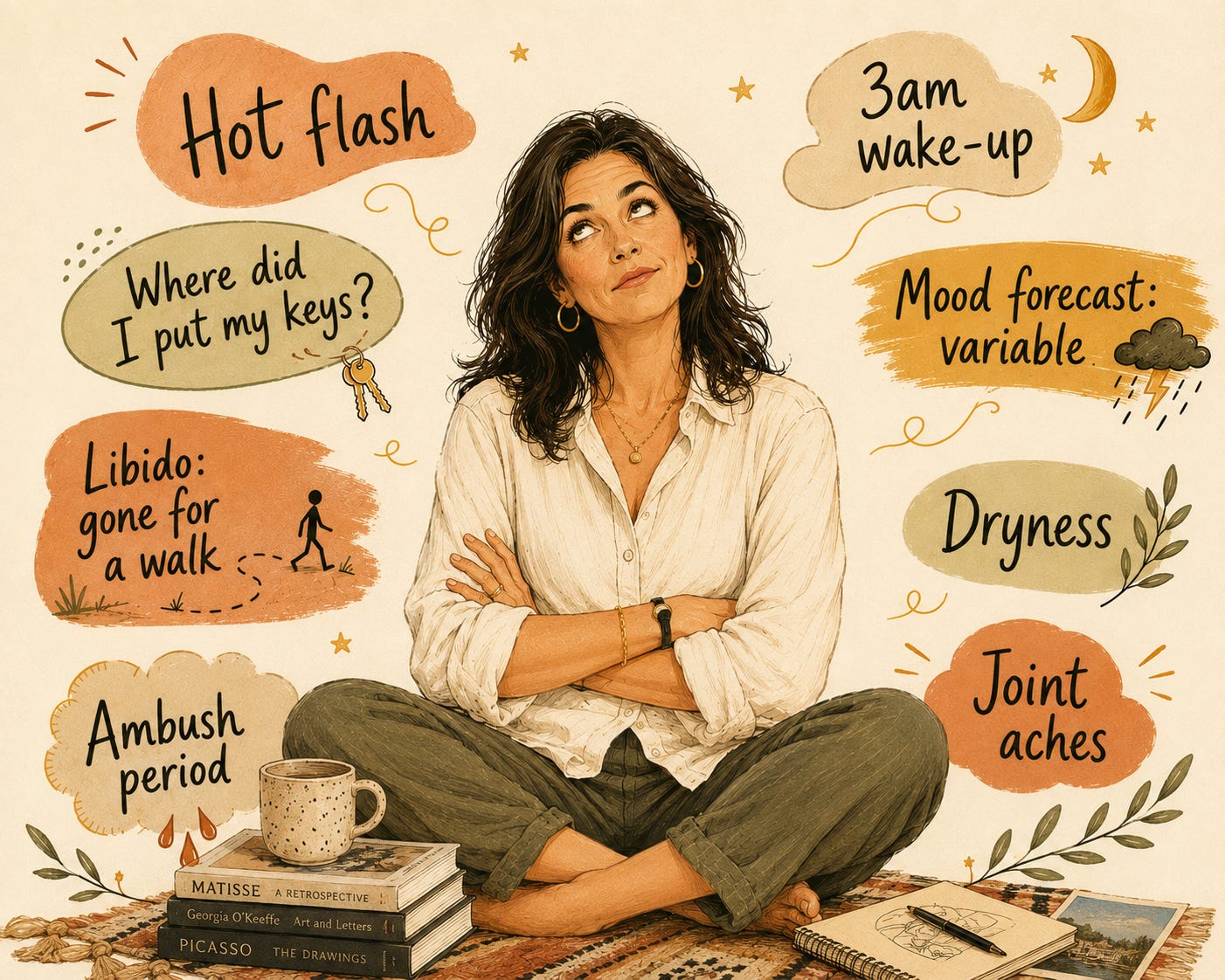
Here is a thing almost nobody says to you plainly, so we will: the years before your last period are often stranger than the event itself, and they can begin the better part of a decade ahead of schedule.
Menopause is a single point — the day twelve months after your final period, which you can only ever identify in hindsight. Everything leading up to it is perimenopause, the long runway, and it does not keep a timetable. The average woman reaches menopause around fifty-one or fifty-two, but the symptoms can start in your mid-forties, and the transition runs three or four years for some and closer to a decade for others. Two women the same age can be living in completely different weather.
And it can start earlier than anyone tells you — forty is not too young to be in it. The list is also longer than the one you were handed. Hot flashes and night sweats, yes — but also periods that turn up early, late, biblical, or as an ambush; sleep that frays at three in the morning; a memory that drops the word it wanted mid-sentence; moods with their own forecast; a libido that quietly left the building; and the genitourinary business no one says out loud — dryness, urgency, discomfort. If you’ve had half of these and been told you’re fine, you weren’t imagining it.
Two more things the list rarely includes: bones and muscle. Estrogen plays a significant role in maintaining both, and as it declines, bone density can drop and muscle mass quietly follows. This is not inevitable — it is addressable, and earlier is better than later. The evidence is consistent: resistance training twice a week, progressively increased, protects both. Protein intake matters more than most women realize at this stage — current guidance sits around 1.2 to 1.6 grams per kilogram of body weight per day. Calcium and Vitamin D are the unglamorous workhorses of bone health and worth discussing with your clinician if you haven’t already. It doesn’t require a complete overhaul. It requires a start.
One genuinely useful thing to carry into the appointment: if you’re over forty-five with these symptoms, you usually do not need a blood test to confirm any of it. Hormone levels swing so wildly from day to day that a single reading can’t pin them down, and a normal result doesn’t mean nothing’s happening. The diagnosis comes from your history and your symptoms — so a doctor who declines to test you isn’t brushing you off; the test is the unreliable thing, not you. (Before forty is a different story, where testing genuinely matters, because early menopause is worth catching.)
And there’s been a real shift worth knowing about. For two decades, every form of menopausal hormone therapy carried the FDA’s sternest “black box” warning — a hangover from one alarming 2002 study later understood to have largely followed women well past menopause, on a formulation since fallen out of use. In early 2026 the FDA removed that warning’s language on heart disease, breast cancer, and dementia, keeping only a narrower caution about the uterine lining for one kind of estrogen. The current understanding, in plain terms: for many healthy women who begin near the transition — under sixty, within ten years of it — hormone therapy is the most effective treatment going for hot flashes and the genitourinary symptoms, and the risks are low. Begin much later, or much further out, and the arithmetic changes.
The other question nobody answers: how long do you stay on it? The old instruction was “lowest dose, shortest time” — guidance since revised as inadequate and in some cases harmful. The current answer from The Menopause Society is that there is no fixed limit. Duration is a conversation between you and your clinician, based on your symptoms, your history, and your quality of life. Some women take it for two years. Some take it for twenty. Neither is automatically wrong.
This is not a flare fired into the sky. The same clinicians who welcomed the change have cautioned against swinging from one tidy story (“it’s dangerous”) to the opposite (“everyone should be on it”). If you’ve had breast cancer, or it sits close in the family, the picture is genuinely yours alone and worth an unhurried conversation. The compounded “bioidentical” pellets and troches sold at some wellness clinics fall outside both the evidence and the regulators — we’d give them a miss. And low-dose vaginal estrogen, the quiet workhorse for dryness and bladder symptoms, is about as low-risk as anything in the cabinet.
None of this is a prescription; it’s a vocabulary. The reason to say it out loud is that you walk into the room able to ask sharper questions — ideally of a clinician who actually trained in menopause, and there are more of them every year. The conversation is finally growing to the size of the thing. About time.
The Hormonal column shares information, not medical advice. Your body, your history, and your own clinician get the last word.