


Four of us, two milestone birthdays, and a chorus of people — some of whom had actually lived there — certain it was the wrong city, at the wrong time, for women like us. We went anyway.
The trip began as an excuse. Two friends had birthdays with a number on them, the sort that seems to demand a passport, and four of us wanted to be somewhere together for it. Where was still open. I closed it. It had to be Rio, and it had to be Carnival — and the moment I said so out loud, I found I had proposed something closer to a public-order offense.
I could write a book about the audience it drew, and one of these days I might. The warnings came from every direction and in every register: wrong city, wrong week, wrong idea entirely, and — always, eventually — the wrong thing for women. Some of the most discouraging came from the people who knew the place best: born there, raised there, long since moved away, who spoke of Rio the way you might speak of a beautiful and volatile ex — with real love, and a firm recommendation that I keep my distance.
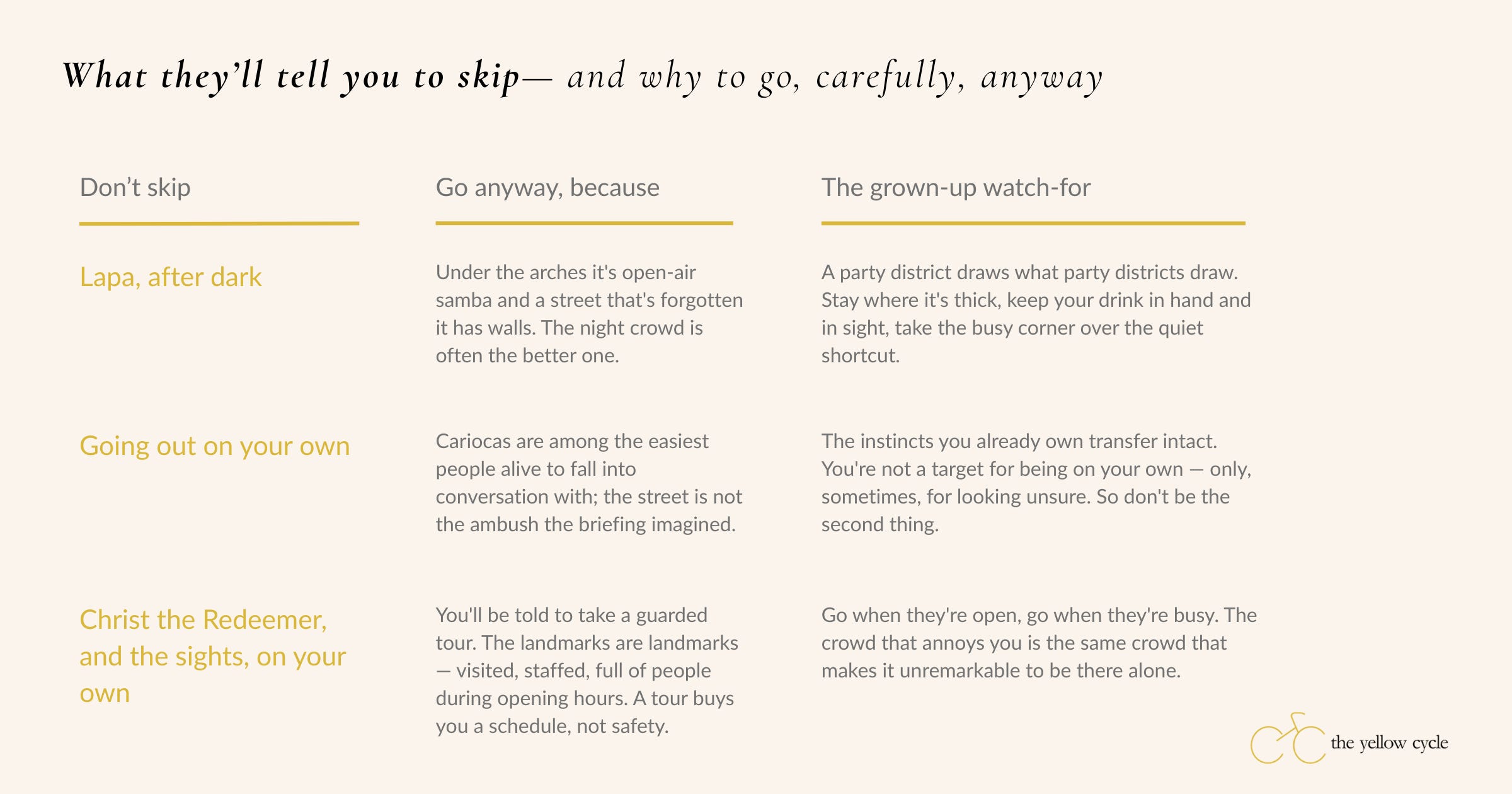
I had the answer ready, and used it often. I grew up in India. I know how to move through a crowded, complicated place.
Which is the distinction the whole chorus kept missing. Every warning had conflated two different instructions into one — careful and away — as though the only safe form a woman could take was a stationary one. Being careful and staying away are not the same instruction. We went. We were careful. Both are true, and being careful never once required staying away.
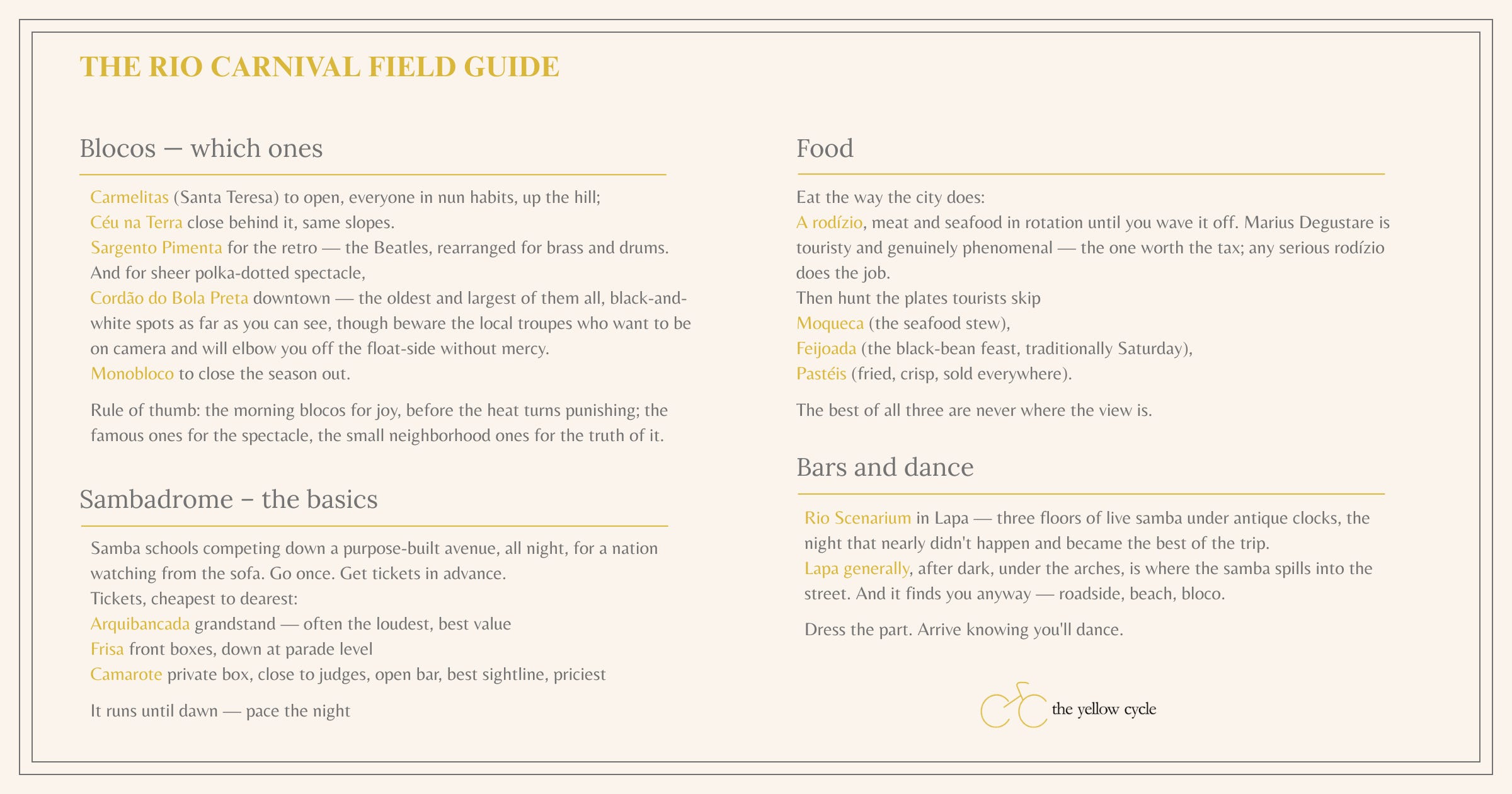
The first bloco swept us up before we were properly ready for it, which is the correct way to meet one. It was Carmelitas, the parade that opens Rio’s street Carnival on the slopes of Santa Teresa, and it runs on one of the better legends going: a cloistered nun who, the story has it, jumped the convent wall each year to join the party and slipped back before anyone noticed. So everyone marches as nuns — the better to hide the runaway in the crowd — thousands of us, in habits, climbing a cobblestoned hill in the heat behind a truck carrying a drum section and a woman singing something the whole street already knew. There is no standing to one side of a thing like that. Within about four minutes you have stopped wanting to.
The birthday friend is the part I keep returning to. We landed and went more or less straight into a bloco, and she — whose week this was — put the costume on but not much else: no makeup, no accessories, in it without being in it. Something about it felt like it belonged to a version of herself she thought she’d retired; she wasn’t sure; she hung at the edge of the thing, half-dressed for it. That lasted exactly one afternoon. From the next morning she was the most committed nun in Rio: fully turned out, every day, every dress code for every bloco honored to the letter, more devout in her costuming than any of the rest of us. I have thought about that conversion more than once since. She didn’t decide her way into the week. She went anyway, unsure, and the place did the rest — which is, more or less, the whole argument for going.
It raises a question I’ve been turning over since we came home: why do any of us go anywhere? You go to see a thing you’ve never seen. You go to stand inside a way of living that isn’t yours and be, for a week, the one who doesn’t know the rules and doesn’t mind. You go because something in you leans toward a place long before you can explain why. You go for reasons that don’t flatter you in the least — to look, frankly, at beautiful bodies, of which Carnival provides a generous surplus. You go to be near art, or food, or noise, or a grade of joy your own sensibly arranged life will never quite manufacture on its own. Not one of those reasons is improved by staying home to be safe.
Somewhere between the morning and the night, you have to eat, and you should eat the way the city does: at a rodízio, the churrasco arriving in rotation, meat and then seafood and then more of both, until you wave the whole parade off. Then go looking for the plates the tourist doesn’t — the stews, the fried things, the dish someone’s grandmother clearly had opinions about. They are everywhere, if you look where the locals are looking.
And the samba is everywhere too — at the roadside, in the blocos, on the beach, and, most decisively, at the Sambadrome: the temple of the whole thing, and a night unlike anything else you’ll see. Go once, however you can get in. Dress the part. Arrive already knowing you’ll dance.
The best night of the trip nearly didn’t happen. We took an Uber to Rio Scenarium — three stories of live samba and antique clocks and chandeliers, in the middle of Lapa — and then sat in the car at the curb, four of us, not getting out, because the street outside read exactly the way we’d been warned all of Rio would read. What finally moved us was, of all things, the police: actual officers standing on the road, which we took, rightly or not, as a sign that this was a corner the city kept an eye on. We got out. We went in. We had, without exaggeration, the night of our lives. The judgment that got us out of that car was not recklessness and it was not fear — it was the same quick reckoning you’d run at home, made consciously in a place you don’t yet know by heart.
So let me be plain about the word, because I am not selling recklessness and never will. You take every precaution there is. You read the street, you mind your things, you make the hundred small adjustments a capable adult makes anywhere she isn’t yet fluent. And some rooms you simply choose not to walk into — the favela baile everyone else seemed to want, in our case, which we left to the people who actually live there. Safety is not the toll you pay to travel; it’s the thing that lets you eat the whole of it and come home greedy for more.
THE FIELD GUIDE — what to actually do, once you've ignored the warnings — Blocos, Sambadrome, Rodizio, and the Samba
It was, and I don’t say this lightly, one of the best decisions I have made — not the best trip, the best decision, which is a larger and more useful thing, because a decision is something you can make again. And I have.
Rio does not lower its voice for anyone’s comfort. For one week, four of us didn’t either — and the world that had been so certain we shouldn’t be there turned out, in the end, to simply be somewhere else.