
Red is demanding. It asks something of you, nine times out of ten. Wear it and you have agreed, whether you meant to or not, to be seen — and a great many of us have a complicated relationship with being seen, which is why a great many of us do not wear red at all.
The difficulty isn’t flat, though. It climbs. Red shoes, most of us can manage; they’re far from the face, deniable, halfway to a joke. A red bag, fine. The red coat asks a little more, and gets talked out of more often. The red dress asks more still. By the time the red reaches the mouth it is asking the most it will ever ask.
Consider the two women the culture keeps for this. Marilyn, whose whole face was organized around the red mouth, the lipstick doing the talking her voice was too soft to. And Taylor: the same deep red, decades apart, and you cannot quite say what it’s doing on either of them — armor or announcement, the loud thing a managed woman is allowed or the quiet point she’s making without raising her voice. That you can’t tell is the whole interest of it. Two women who could not be less alike, reaching for the identical tube.
So the mouth is where it all concentrates. It is where even the women who wear red everywhere else finally hesitate, and where the women who wear it nowhere feel the whole business start — at the lips, and working backward.
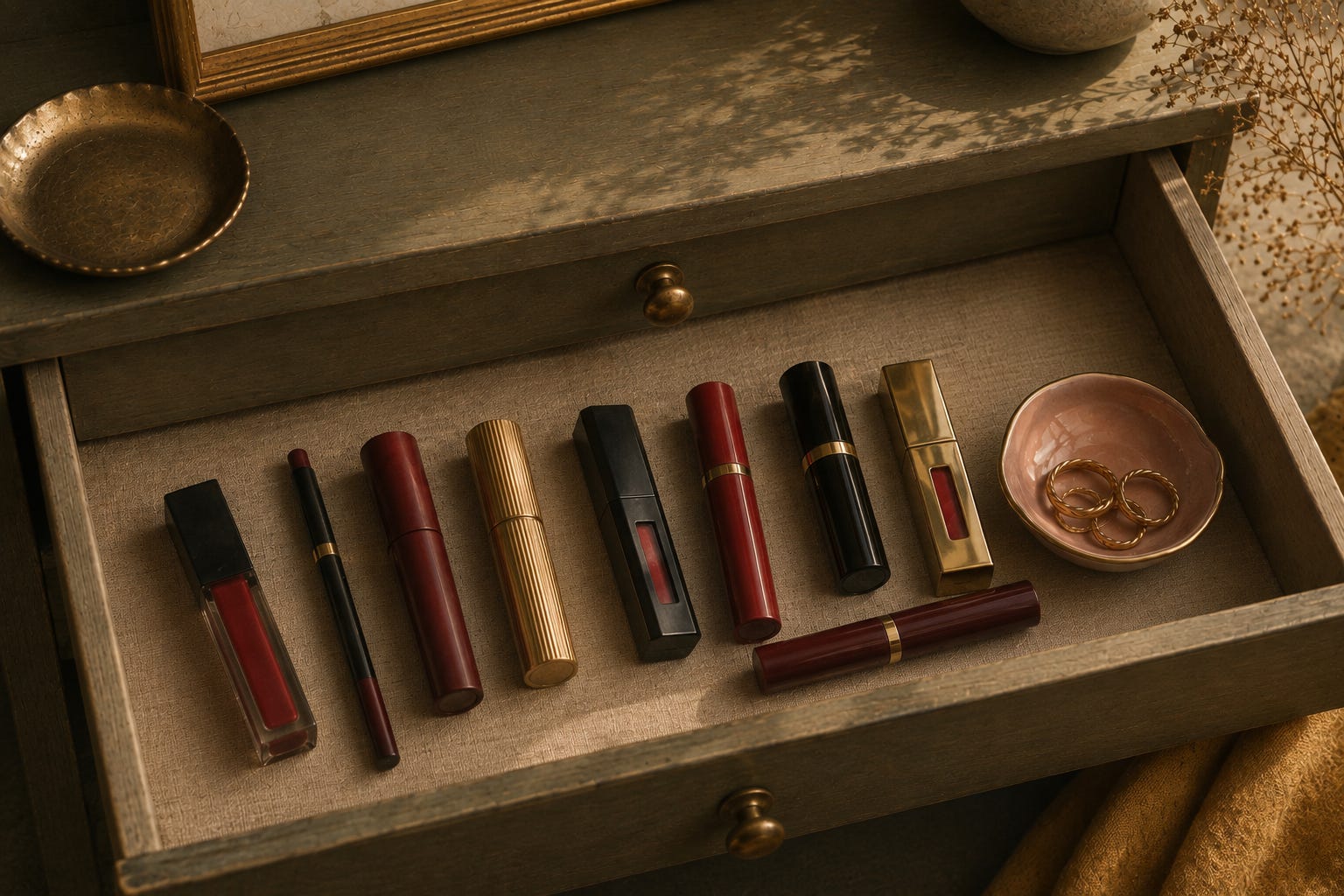
Somewhere in most drawers is the evidence. Several reds, not one — a scarlet bought in a decisive mood, a brick that felt safer, a blue-red someone swore was universal, a berry for later. Ten, if we’re counting, and we are. Ten shades acquired over years, each one still capped, still pristine, still perfect.
The shade was never the obstacle. A woman who owns ten reds and wears none of them does not have a shade problem. She has something else — and it is worth being careful about what we call it.
Here is what makes the lip the far end of the scale, and it isn’t vanity. The mouth is the part of you that is most you — where the words come out, where you eat, where you are kissed, the first thing another face reads. Color on the shoe decorates. Color on the mouth declares. Red there is something you announce, and the announcement is always the same: I am here, I meant to be looked at, I chose this.
That is a large sentence to say before nine in the morning. Some of us are not sure we have cleared ourselves to say it. And some of us simply decide not to. That is a different choice altogether.
Because here is what the drawer is not. It is not a waiting room. It is not ten failures to wear a lipstick, ten deferrals, ten someday-when-I’m-braver. Look at what a woman actually did: she was drawn to the red, and she bought it, and then she was drawn to it again, and bought it again, ten times over, across years. The wanting is real, and repeated, and entirely hers. She just keeps it where no one can see it — renewed every time she brings another one home, and answerable to nobody.
There is an argument that this is the more intimate red. The worn red is a statement made outward, to a room. The drawer of ten is a conversation a woman is having with herself, ongoing and unfinished and private, and no one’s business but her own. It would be a strange kind of progress to talk her out of it.
So we won’t. If you own ten and wear none, this is not the paragraph that fixes you, because you are not broken. And if you own ten and want, one of these mornings, to put one on — that is yours too, and there is a map for it below, sorted not by your undertone but by the size of the thing you feel like doing.
But first, the question the drawer actually asks. When you buy the tenth one, what is it you think you are buying?
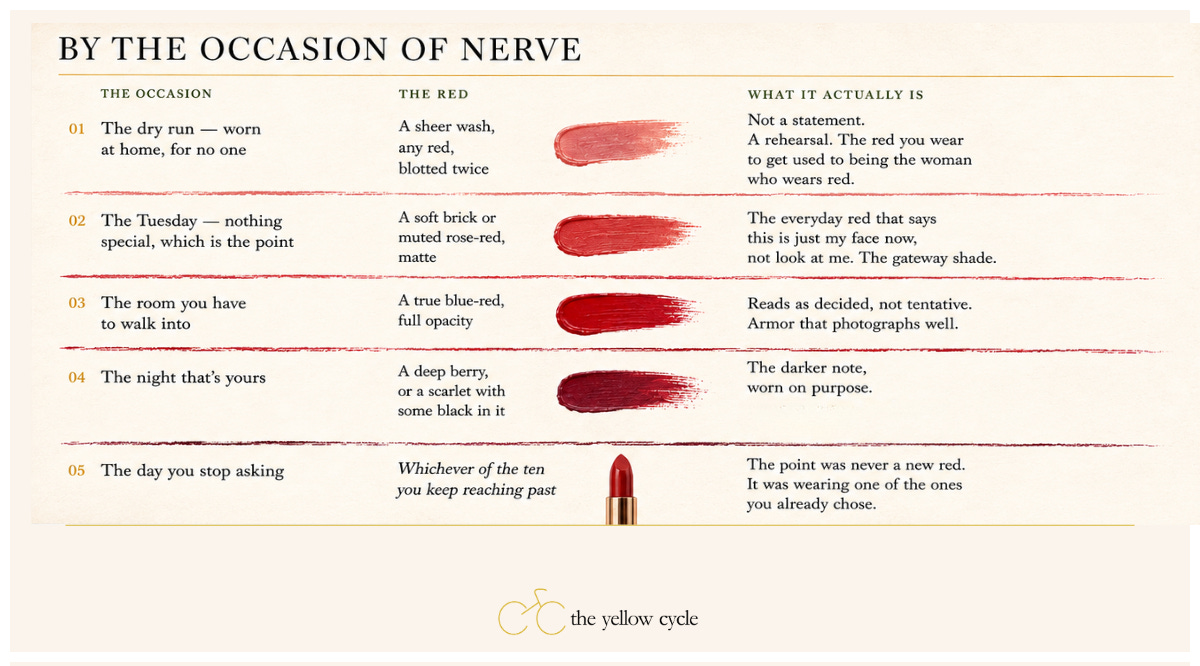
And then, because someone will always ask for the practical one.
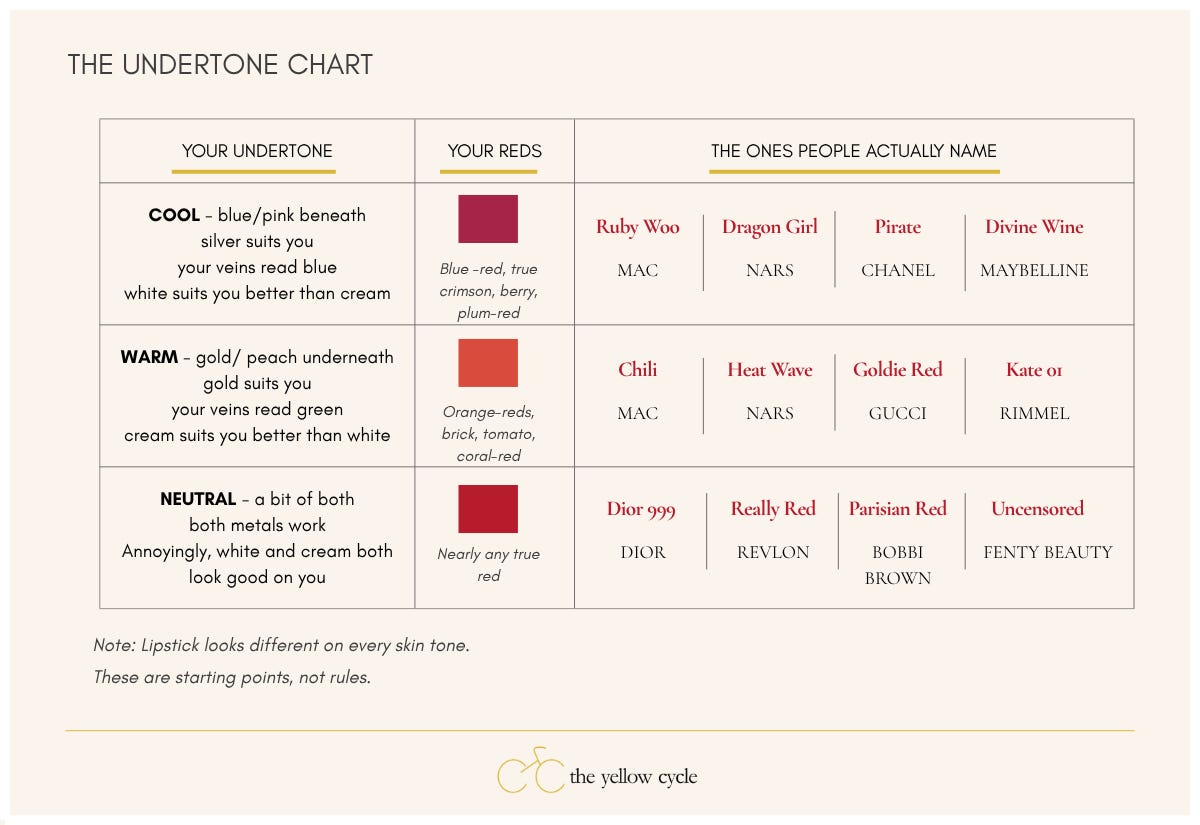
We’d hoped to get through this without it. But utility is utility, and the undertone chart — unchanged since Carole Jackson put it in every drugstore and every magazine your mother read in 1980 — remains stubbornly, annoyingly correct. So here it is, played straight. Match your undertone; ignore your nerve. That part, as established, is on you.
You have the reds. You’ve always, always had the reds. Worn or not, they were always yours.