
This is the first of these, so we should start with the history most money columns are too well-mannered to mention.
For most of the time money has existed, women had none — not by oversight but by design. She married, and what had been hers became his; if she earned, her wages were his; the law across much of the world said so without embarrassment. And it ran deeper than money. In a great many places, across a great many centuries, a woman was not a person forbidden from owning property. She was the property — chattel, a vessel for continuing a man’s line, a thing that moved between households with a settlement attached. It is recent enough that the residue is still in the water, and the residue has a modern name.
The name is the flinch — that small internal stammer a woman still feels quoting her worth without shaving it first, asking for the raise, saying out loud what she earns, talking money at a table where the men are doing it untroubled. We’re taught to read the flinch as good manners, but it is inheritance: the long echo of centuries in which money was, quite precisely, not her business, on the grounds that she was nearer to being the goods. You didn’t invent that discomfort. It was issued to you, and most women carry a share of it without ever being handed the receipt.
The standard portrait of a stable financial life, then, was never sketched with her in the room. Look up financial stability and you’ll get a version of this: a state in which a person can comfortably meet their costs, service their debts, and take a shock without living in constant money stress. Dependable income, controlled spending, a safety net. A perfectly sound definition that skips the one question deciding everything for a woman, and skips it with a straight face. It asks whether the income is dependable. It never asks whose it is.
Because by that definition, a woman with none of her own money is stable, so long as somebody else’s arrives on schedule. She passes every test, owns not one line of it, and hasn’t the faintest idea what becomes of her the day the arriving stops. The measure checks whether the bills get paid, not whether the woman paying them is the one who decides — the same assumption the whole history ran on, now hiding inside a dictionary.
So let’s settle what it means for money to be yours, since everything turns on it. It has nothing to do with whose hands earned it. Money is yours when you hold the right to decide what happens to it — spend, save, invest, give away, or refuse to part with it — without anyone’s sign-off. A woman in a real partnership, with genuine say over what the household does with its money, owns it by this measure whatever payslip it arrived on. A woman whose every comfort is provided but who must ask, itemize, and justify does not, however handsome the provision. Ownership is who decides, not who earned and not who benefits. Hold onto that; the whole ladder stands on it.
So we need our own measure — a truer one, not a gentler one. It starts with what stability is not: it is not being rich. That mix-up has kept a lot of capable women awake over a target they were never chasing. Stability isn't a number trailing zeros; it's the point where ordinary life stops feeling financially fragile — where a surprise bill is an annoyance rather than a catastrophe, and a bad month is weathered rather than survived. Rich is a place almost nobody arrives. Un-fragile is a position most women can build on purpose, in stages. They look like this.
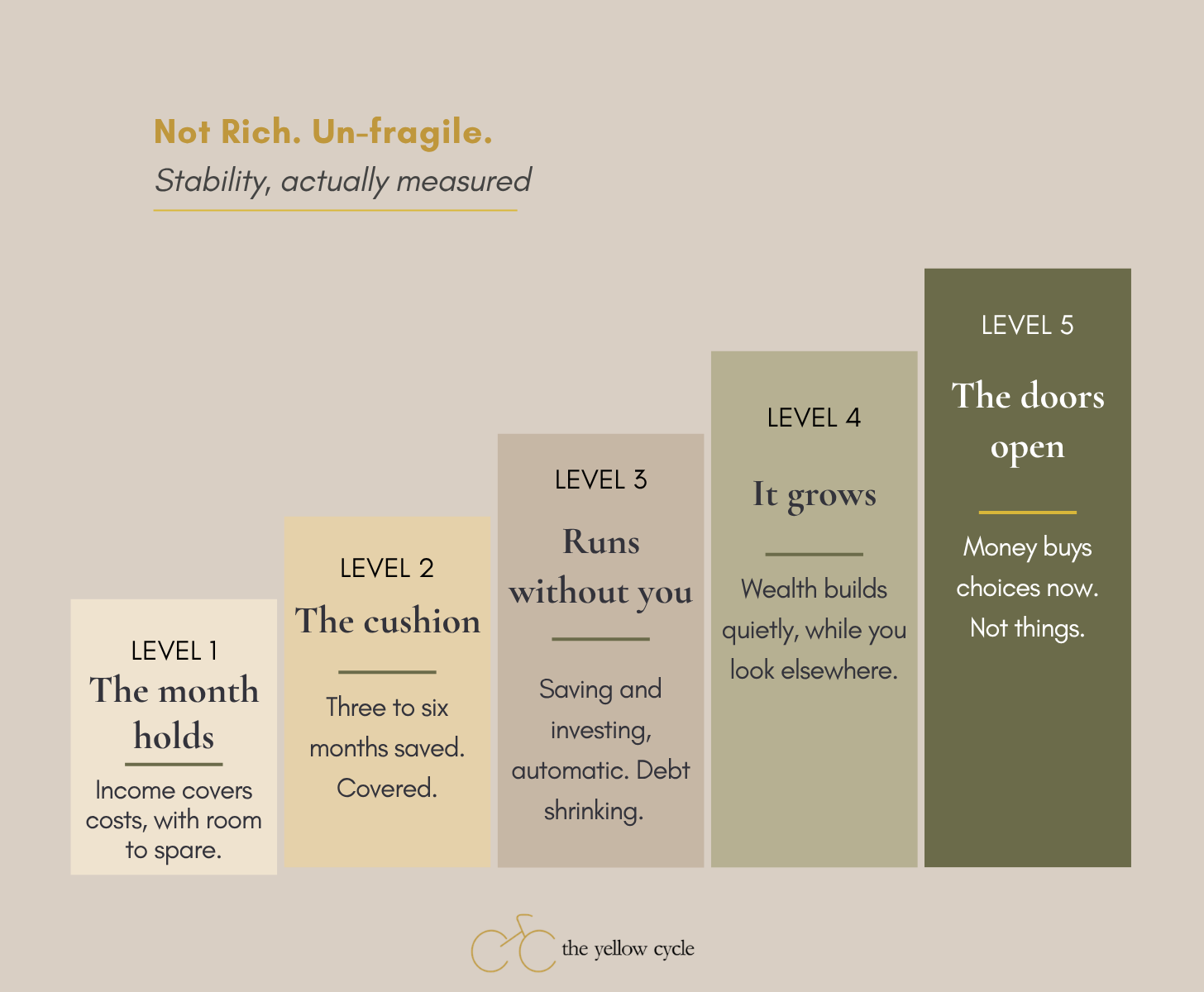
Level One — the month holds. Income beats outgoings. Rent or mortgage genuinely affordable, not white-knuckled on the first. Bills paid on time, groceries covered, transport you can count on, no payday loans, no credit-card balance rolling forward — and something left over, however slim. Everything else is built on it.
Level Two — the cushion. Where resilience starts. One month’s expenses saved, then three, eventually six — more if your income is self-made and moody. Health cover; disability cover if your income depends on you turning up to earn it; life cover if someone depends on yours. High-interest debt brought to heel. Life will still throw a punch, or five. You simply stop being knocked flat by each one.
Level Three — it runs without you. The machinery stops needing daily supervision. Saving happens on its own; so does investing. The emergency fund sits untouched, because it’s for emergencies and this — the sale, the sofa — is not one. Credit healthy, nothing missed, debt shrinking rather than sidling upward, spending aligned with what you value rather than what you felt at nine in the evening. Perfection was never the aim. Predictability is.
Level Four — it grows. Wealth accumulates quietly while your attention is elsewhere. The vehicles vary, and this column won’t prescribe them from a single list — retirement accounts, index funds, the employer match you’d be unwell to leave on the table, property where it fits, equity. Each deserves its own hour, and will get one in these pages — consider this the table of contents, not the meal. And underneath every rung is the one asset no list of vehicles includes: your own earning power. The skill that lets you charge more is among the best investments anyone makes, and the only one nobody can quietly transfer out from under you.
Level Five — the reason for all of it. Here money stops being about things and turns into choices. Can you leave the job that costs more than it pays? Take six months out? Care for a parent, help a child without capsizing yourself, start the thing you've circled for years? Say no — to the client, the situation, the person — and mean it, and afford it? That is the real wealth: not a heap, but a corridor of doors that open when you lean on them. Its place at the top is no accident, because to leave, to refuse, to provide, to go are exactly the freedoms the history withheld. Optionality is no flourish. It is the old inheritance, taken back.
Which brings me to the part the sensible articles leave out. None of this is a vow of austerity. Money that is yours isn’t for hoarding in a joyless pile while you admire your own restraint — it’s for spending, some of it, magnificently, on things you wanted and earned and chose. There’s a specific pleasure in buying something with money that is unmistakably your own: the coat or the meal or the flight that is yours twice over, once because you bought it and once because you made what bought it. The freedom worth building isn’t only the freedom to walk away from things; it’s the freedom to walk toward them, with no knot in the stomach and no case to plead. That is not the opposite of building wealth. It is what the wealth was being built for.
So: not rich. Un-fragile, and rising. Some women who look precarious on paper turn out steadier than anyone at the table, and some who photograph beautifully are quietly sliding. You’ll finally know which you are, because you’ll be measuring the right thing — not whether the bills got paid, but whether the woman paying them is the one who decides.
Money, Honey shares information, not financial advice. The instruments that suit one woman’s life are wrong for another’s, and no column knows your numbers. Your situation, your goals, and — when the stakes warrant it — a fee-only advisor who answers to you get the last word.